
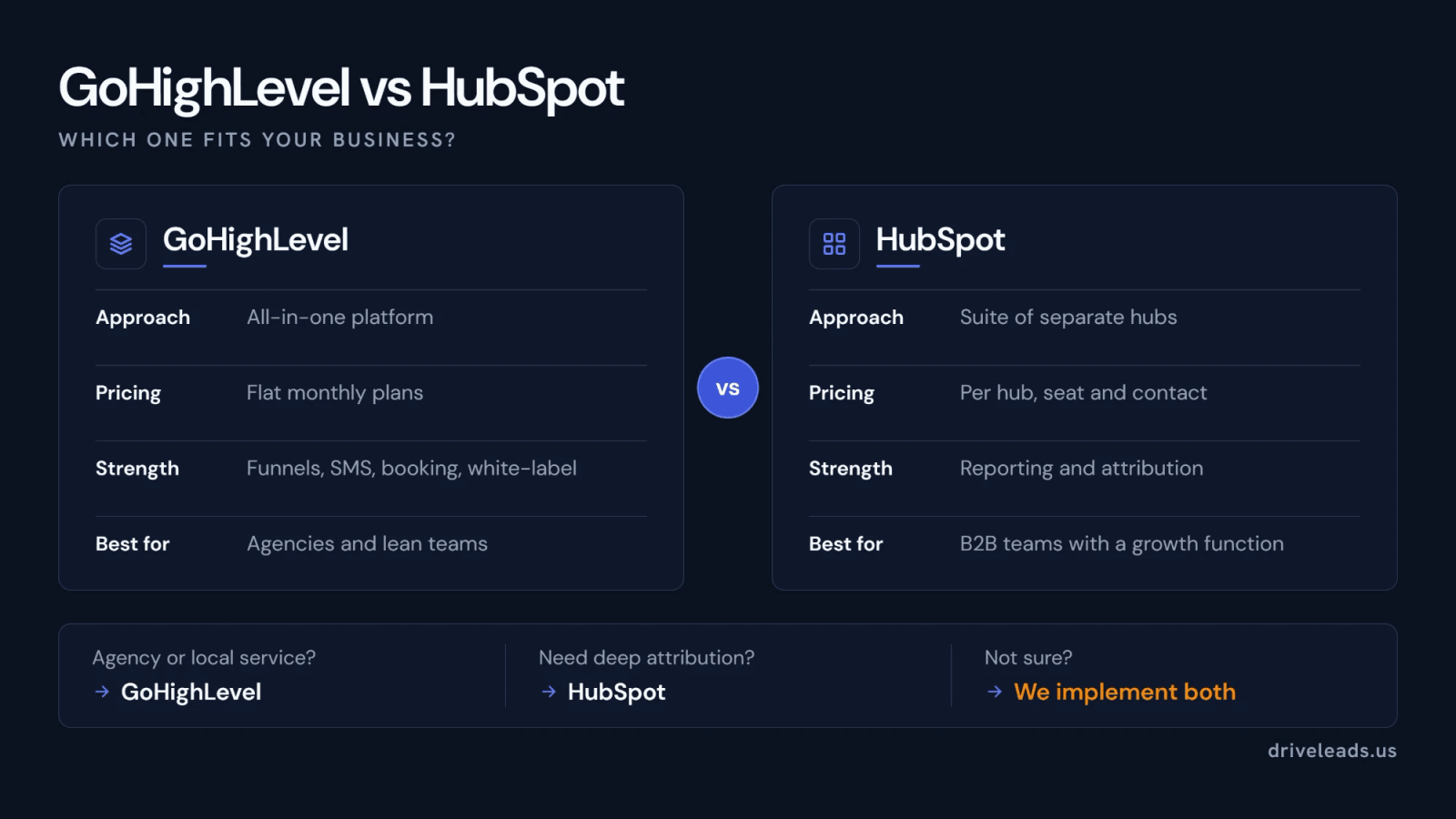
The most common question we get from founders is some version of: “Should we be on GoHighLevel or HubSpot?” Most agencies answer with whichever tool they happen to resell. That is backwards. The right platform depends on your business, not on ours, and we implement both, so we have no reason to push you to one.
GoHighLevel vs HubSpot: The Short Answer
| Your situation | Better fit |
|---|---|
| Agency that resells software or runs client accounts | GoHighLevel |
| Local service business that needs funnels, SMS, and booking | GoHighLevel |
| Bootstrapped or lean team that wants one flat price | GoHighLevel |
| B2B team with separate marketing, sales, and service functions | HubSpot |
| You need multi-touch attribution and deep reporting | HubSpot |
| You rely on a large library of third-party apps | HubSpot |
| Enterprise scale and governance | Neither: look at Salesforce |
Our rule of thumb on stage: bootstrapped teams up to roughly $2M in ARR usually lean toward GoHighLevel, and companies between roughly $2M and $50M with a growth team in place usually lean toward HubSpot. It is a rule of thumb, not a law, and the table above matters more than the revenue number.
GoHighLevel vs HubSpot Pricing
Pricing is where the two differ most, because they charge in different ways. GoHighLevel sells flat monthly plans. HubSpot sells by hub, by seat, and by the number of marketing contacts.
| GoHighLevel | HubSpot Marketing Hub | |
|---|---|---|
| Entry | Starter, $97 a month | Free, then Starter from $7 a seat a month at the current promotional price |
| Mid tier | Unlimited, $297 a month | Professional, from $800 a month with 3 seats and 2,000 marketing contacts |
| Top tier | Agency Pro, $497 a month | Enterprise, from $3,600 a month with 5 seats and 10,000 marketing contacts |
| Required onboarding | None | $3,000 one-time for Professional, $7,000 for Enterprise |
| What scales the bill | Usage such as phone, SMS, email, and AI | Seats, marketing contacts, and hubs |
Prices were checked on October 17, 2026 on each company’s pricing page: GoHighLevel pricing and HubSpot Marketing Hub pricing. Both change, so confirm before you decide. Two caveats keep the comparison honest. The HubSpot figures are Marketing Hub only, and Sales Hub and Service Hub have their own pricing pages. And the GoHighLevel plan price is not the whole bill, because phone, SMS, email, and AI usage are billed separately on top. For a full breakdown of the platform side, see our guide to GoHighLevel pricing.
Features Side by Side
| GoHighLevel | HubSpot | |
|---|---|---|
| Approach | One platform with CRM, funnels, email, SMS, booking, and automation | A suite of hubs for marketing, sales, and service |
| White-label and client accounts | Built in, with sub-accounts | No equivalent |
| Reporting and attribution | Solid pipeline and funnel reporting, shallower for multi-touch attribution | Deep reporting and multi-touch attribution |
| App ecosystem | Native tools plus API and automation connectors | Over 2,000 apps listed by HubSpot |
| Setup | Powerful but steep, and worth building properly once | Easier to start, with cost rising as you add hubs |
When GoHighLevel Wins
GoHighLevel is the right call when you need a complete revenue stack without enterprise overhead or enterprise pricing. You get CRM, funnels, email, SMS, and booking on a flat plan, and the same account can serve client sub-accounts if you run an agency. A focused build can be live in three to six weeks, and that speed matters when a founder-led team needs results this quarter. If this is your direction, our GoHighLevel setup service covers scope, price, and timeline.
When HubSpot Wins
Once you have a head of growth in place and revenue leaking between marketing, sales, and service, the hubs need to work together. HubSpot’s advantage is depth: multi-touch attribution, unified reporting, and account-based workflows. Implementation usually takes longer and costs more, but at that stage the visibility pays for itself. Our HubSpot implementation service is built for that situation.
Migration and Lock-In
Moving between the two is possible in both directions, which is why the first choice is not a trap. Going from HubSpot to GoHighLevel, HighLevel’s own HubSpot Importer brings over contacts, deals as opportunities, companies, custom fields, pipelines and stages, notes, tasks, and emails. Workflows, forms, and email templates still have to be rebuilt, which is where most of the effort goes. We walk through the full process in our guide to migrating from HubSpot to GoHighLevel. Going the other way, from GoHighLevel to HubSpot, is a migration we handle as well.
The Honest Trade-Off
GoHighLevel is not “HubSpot lite,” and HubSpot is not “overpriced GoHighLevel.” The mistake we see most often is a small company paying for HubSpot it cannot fully use, or a larger company straining against GoHighLevel’s reporting ceiling. Pick the platform for the stage you are in, not the stage you aspire to, and move when you cross the line.
Not sure which side of the line you are on? Tell us about your business and we will recommend one platform honestly, even if it is the one we implement less often. Or compare the GoHighLevel setup service with the HubSpot implementation service.